
Why a wall hold works on your arteries
In July 2023 the British Journal of Sports Medicine published a review of 270 randomized trials covering 15,827 people. Isometric exercise, which means holding a muscle still under tension, lowered resting systolic pressure by 8.24 points on average. Aerobic training lowered it by 4.49 points. Among single exercises, the isometric wall squat ranked first for the top number.
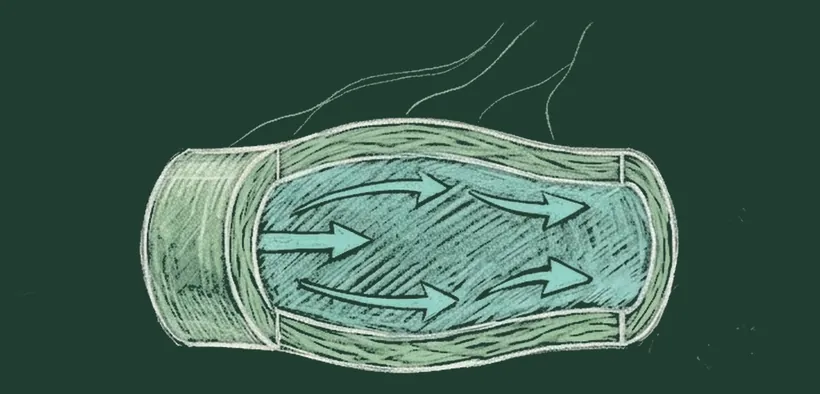
Most of the effect seems to come from the rest periods. While you hold the wall, your thigh muscles squeeze the small vessels running through them. When you stand up, blood rushes back in, and that faster flow rubs along the inner lining of the artery. The lining answers by making more nitric oxide, a gas that helps the vessel wall relax. Repeat that a few times a week and resting vessel tone tends to settle lower over the following weeks.
Weeks 1 and 2: the 4-minute starter ramp
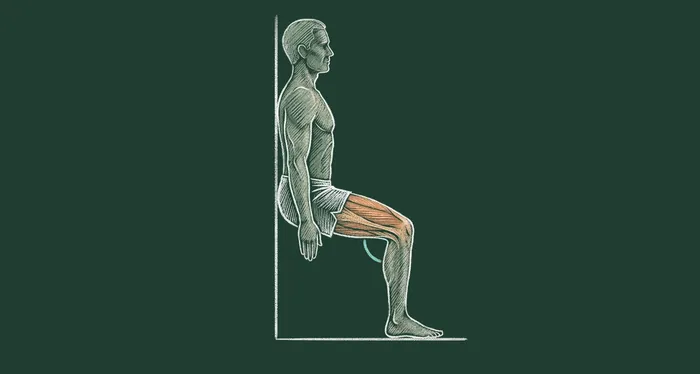
The research schedule is a lot for someone who hasn't held a squat in years, so start with half the holding time.
- Total holding time: 4 minutes per session, 3 non-consecutive days a week.
- How to split it: four 1-minute holds, or two 2-minute holds.
- Rest: 2 full minutes between holds, sitting or standing easy.
- How low: stay high on the wall, with your knees bent somewhere between about 115 and 135 degrees. You don't need a 90-degree "invisible chair."
- How hard: about 4 to 6 out of 10. Your thighs should feel warm by 60 to 90 seconds, with no knee pain.
- Form: heels flat and hip-width apart, lower back resting lightly on the wall, knees pointing straight over your toes.
Once 4 minutes feels steady and your knees feel fine the next morning, add a third 2-minute hold in week 3. Move up to the full schedule below only when your legs handle it smoothly.
The full clinical schedule (4 × 2 minutes)
This is the routine used in the UK home-based trials, including the 2019 study by Taylor and colleagues:
- 4 holds of 2 minutes each
- 2 minutes of calm rest between holds
- 3 non-consecutive days a week
- About 14 minutes per session, 8 of them spent holding
In those trials the wall height was set for each person so they reached a moderate heart rate or a moderate effort. Nobody was asked to hold until their legs gave out.
If wall sits bother your knees: the handgrip option
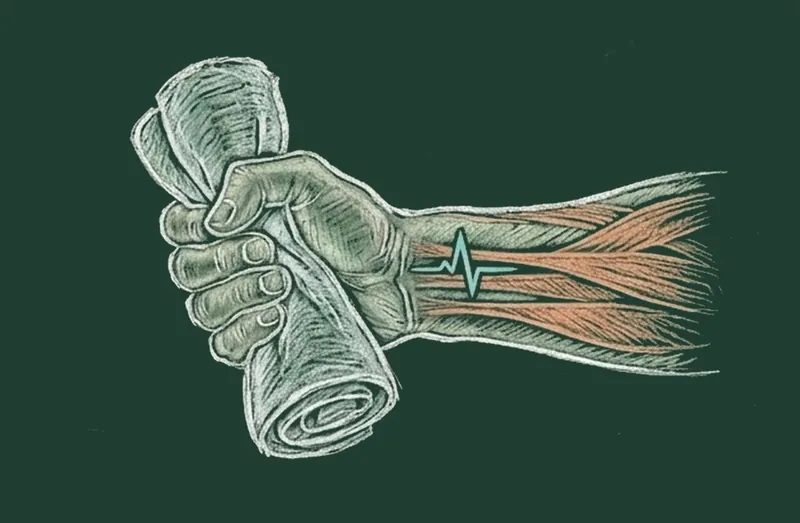
For sore knees, knee arthritis or a knee replacement that won't tolerate wall sits at any height, trials tested handgrip holds. They put no load on your knees or hips.
- Squeeze a spring gripper or a rolled-up towel at about 30% of your full grip strength.
- Hold for 2 minutes, then switch hands, resting 1 to 2 minutes between holds.
- Do 4 holds in total, 3 days a week.
Reviews of isometric training, mostly handgrip studies, report resting drops of roughly 6 to 8 points on the top number and 3 to 4 on the bottom number. Large leg muscles usually produce a bigger response, so keep the handgrip for when the wall isn't an option.
Three mistakes that blunt a session
- Holding your breath. Around second 70, most people clench their jaw and stop breathing. Straining against a held breath pushes pressure up inside your chest, and when you finally let the air out, blood pressure and heart rate jump. Count out loud every 10 seconds or breathe out slowly through pursed lips. If you can say a short sentence while holding, you're breathing fine.
- Sliding too low. If your legs shake hard by second 40 or your knees ache within 20 seconds, move up the wall. Steady, moderate tension for 1 to 2 minutes does more than a 30-second burn.
- Cutting the rest short. The rush of blood that triggers nitric oxide happens while you rest. Set a kitchen timer for 2 minutes on the wall and 2 minutes off.
Talk to your doctor first if any of these apply
- Your resting readings are very high or uncontrolled, around 180 over 120 or higher.
- You've had recent chest pain, or you have an unstable heart rhythm.
- You take blood pressure medicine. Never lower or stop a prescription on your own, even if your numbers improve. Bring your log to your doctor so they can adjust the dose safely.
Stop the hold and sit down if you feel dizzy, get chest pain or unusual shortness of breath, or feel sharp pain in a knee.
What to expect, week by week
- Day 1: warm, relaxed thighs. Pressure may dip for a few hours after the session, but tomorrow morning's reading will likely look the same.
- Week 2: the holds feel steadier and breathing through them becomes automatic. Morning numbers still move with salt, sleep, stress and hydration.
- Week 4: this is when trials start to measure steady drops in resting pressure. In Taylor's 2019 trial of adults with stage 1 high blood pressure, some groups averaged drops of roughly 12 points on the top number. Individual results vary a lot.
- Weeks 8 to 12: judge progress by your 7-day morning average. Single readings bounce around all day.
The research has limits worth knowing. People in these trials know they're exercising, so the studies can't be blinded. Universities use slightly different knee angles and effort targets. The big review mixes people with normal, borderline and treated high readings, so your own drop depends on where you start. And wall holds have far fewer multi-year studies than walking does. They work best as an addition to your walks.
Nutrients studied for vessel tone
Food, movement and any medicine your doctor prescribes come first. The nutrients below have the most published research on blood pressure and vessel relaxation. Where trials measured an average effect, it's listed, and you'll see the effects are smaller and less consistent than from regular exercise.
| Nutrient | Where it's found | What the research found | Check with your doctor first if |
|---|---|---|---|
| Dietary nitrate | Beets and beet juice, arugula, spinach, celery | A review of 16 trials found systolic pressure about 4.4 points lower on average (Siervo, 2013). The body turns part of the nitrate into nitric oxide. | You take nitrate heart medicine or erectile dysfunction medicine. |
| Hibiscus | Hibiscus tea made from the dried flowers | Three cups a day for 6 weeks lowered systolic pressure by 7.2 points, against 1.3 with placebo, in 65 adults with mildly raised readings (McKay, 2010). | You take a diuretic or other blood pressure medicine, since the effects can add up. |
| Garlic | Garlic, aged garlic extract | In people with high readings, garlic preparations lowered systolic pressure by about 8 points on average (Ried, 2016). Most of those trials used aged garlic extract. | You take a blood thinner such as warfarin, or have surgery coming up. |
| Potassium | Beans, potatoes, bananas, leafy greens, yogurt | Eating more potassium lowers blood pressure, most clearly in people with high readings or a salty diet (Aburto, 2013). It's a core part of the DASH eating pattern. | You have kidney disease or take an ACE inhibitor, an ARB or a potassium-sparing diuretic. Don't take potassium pills without your doctor's OK. |
| Hawthorn | Leaf and flower extracts | A few small trials show modest drops and others show none. The evidence is thinner than for the nutrients above. | You take digoxin or other heart medicine. |
Supplements aren't tested the way medicines are, and the contents don't always match the label. If you try one, look for a third-party testing mark such as USP or NSF and tell your pharmacist what you take.
Research mentioned
- Edwards JJ, Deenmamode AHP, Griffiths M, et al. Exercise training and resting blood pressure: a large-scale pairwise and network meta-analysis of randomised controlled trials. British Journal of Sports Medicine. 2023;57(20):1317-1326.
- Taylor KA, Wiles JD, Coleman DA, Leeson P, Sharma R, O'Driscoll JM. Neurohumoral and ambulatory haemodynamic adaptations following isometric exercise training in unmedicated hypertensive patients. Journal of Hypertension. 2019;37(4):827-836.
- Carlson DJ, Dieberg G, Hess NC, Millar PJ, Smart NA. Isometric exercise training for blood pressure management: a systematic review and meta-analysis. Mayo Clinic Proceedings. 2014;89(3):327-334.
- Siervo M, Lara J, Ogbonmwan I, Mathers JC. Inorganic nitrate and beetroot juice supplementation reduces blood pressure in adults: a systematic review and meta-analysis. Journal of Nutrition. 2013;143(6):818-826.
- McKay DL, Chen CY, Saltzman E, Blumberg JB. Hibiscus sabdariffa L. tea (tisane) lowers blood pressure in prehypertensive and mildly hypertensive adults. Journal of Nutrition. 2010;140(2):298-303.
- Ried K. Garlic lowers blood pressure in hypertensive individuals, regulates serum cholesterol, and stimulates immunity: an updated meta-analysis and review. Journal of Nutrition. 2016;146(2):389S-396S.
- Aburto NJ, Hanson S, Gutierrez H, Hooper L, Elliott P, Cappuccio FP. Effect of increased potassium intake on cardiovascular risk factors and disease: systematic review and meta-analyses. BMJ. 2013;346:f1378.
Last reviewed November 2026. Spotted an error? Use the contact link at the bottom of the page.